Saint Joan
The latest revival of Bernard Shaw’s text, Raw Material’s no-holds-barred rendition of Saint Joan highlights the role of the younger generation in leading revolutionary movements through history and today.
3/13/20267 min read


Originally written by George Bernard Shaw in 1923 and now reimagined by Stewart Laing, Raw Material’s Saint Joan is a prescient retelling that feels especially relevant in our current political climate. With minimal set consisting of a tall floor lamp style lighting rig upstage right and a large rectangular block ‘screen’ with some faint markings delineating the viewscreen of a camera set at a 45 degree angle between upstage and stage left alongside spoken cinematography this is a contemporary staging of a classic text that has had several adaptations.
Raw Material’s Saint Joan utilises a one-man Chorus (Martin O’Connor) providing spoken cinematographic directions taken from Shaw’s own screenplay adaptation, one that was never filmed despite there being several other film and television versions currently available. Combining elements from both Shaw’s original play, his unrealised screenplay, and staging the show in such a stripped back manner Laing ensures the audience does not get distracted by ‘the spectacle’ of Joan’s life and death but instead focuses in on the very human nature of Joan and the very real threat posed by figures of authority when they feel threatened.
Attended 12 March 2026
The Lemon Tree
“I’m not here to be polite – I’m here to say we deserve more”


The soundscape that underscores the battle for the forts does get quite loud, with some moments where even the use of a microphone doesn’t make O’Connor’s narration audible – never mind the rest of the cast who remain unmic’d – however it does certainly add a sense of the frantic chaos of warfare, which ultimately adds to the atmosphere. The use of a remix of Charli XCX’s 360 upon Joan’s capture was unexpected but not unlikable, the lyric video being displayed on the large white screen block that has been dominating the space. It is in this pseudo interval that the set gets altered, the screen being moved from its 45 degree angle to being straight on to the audience (now covering the ground upstage and upstage left) while six chairs are placed downstage, all facing the audience. The ‘Trial’ is dimly lit, giving weight to the oppressive atmosphere, which is heightened by the sinister figure of the executioner (Manasa Tagica) silently waiting throughout the scene. While all of the men wear identical large black hoodies, only the executioner has his hood up and sits leaning forwards, and Joan is dressed in a school blazer – perhaps to emphasise to the modern audience that she was only 19 years old when tried and convicted of heresy. While I’m not sure if it was intentional or simply due to time I quite liked that Brother Martin (Lewis MacDougall) – the only one actively pleading with and trying to help Joan – is the only church man with some colour in his costume (courtesy of his blue socks) which provides a slight visual connection between them, as Joan’s blazer is lined with red piping.
A small issue I had with the end of this scene lies in the prop statement – we see Brother Martin franticly writing it before reading it aloud to Joan however due to the placement of the chairs in relation to the audience (which, to be clear, I felt quite effective) we can very clearly see that the paper is blank. While this does make the ‘Joan’ that gets written stand out very clearly later it is difficult to ignore that as it is currently being staged she is signing a blank statement (which certainly has its own merit as a political commentary, it just simply isn’t supported by the text preceding it). This is not to say that the text as said should be written on the page, however having something written or scribbled in the effect of cursive writing (standard line size) with a thinner pen so that there is something on the page and the audience don’t see a blank paper would also add some more gravity Joan’s signing and eventual destruction of the paper while not diminishing the visual effect of the signed ‘Joan’ as it is shown to the audience as proof of her confession.


Michaella Fee’s lighting design is deceptively simple and highly effective as a visual representation of Joan’s fortunes and struggles. Due to the lighting state not changing at the beginning of the show there were one or two audience members on their phones who didn’t quite notice the entrance of Joan (Mandipa Kabanda) signalling the play starting – presumably they were waiting for the house lights to go down and stage lights to come up first. By keeping the audience lit as well as the stage Raw Material effectively minimises the separation between the characters and the audience – our role as silent spectators becomes a part of the piece. Chorus’ direction of ‘slow dissolve’ to indicate scene changes is accompanied by the lighting rig on stage giving a single pulse throughout the piece but the true changes to the lighting take place during the battles and Joan’s trial. Here the warm wash that had bathed the stage and audience in light is lost, replaced with a more subdued lighting focused on the actors, indeed the audience remains unlit for the second half of the play not because our role as spectator is any less relevant but because Joan has seemingly lost all support.
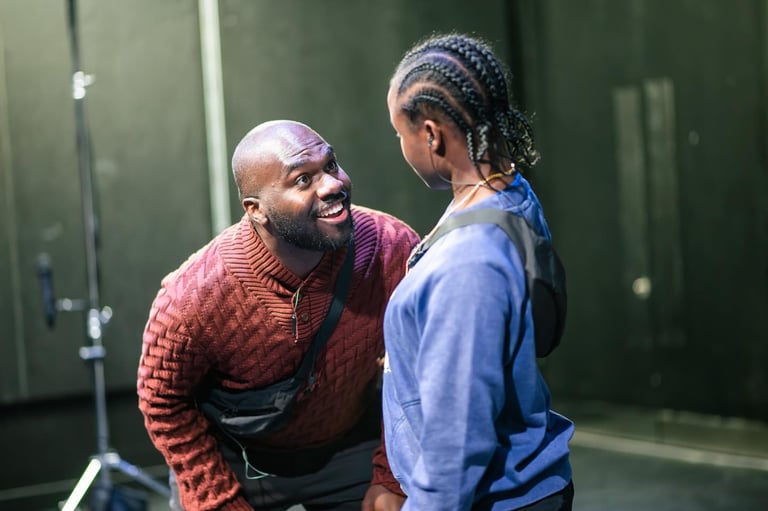
Kabanda gives a powerful performance as the titular Joan and holds up well against her more seasoned cast mates; I would not have known this to be her professional stage debut had it not been mentioned in the program. Beyond Joan the other characters are split between the five male cast members who must multirole, mostly without costume changes which does risk confusion however this is somewhat mitigated by the narration provided by Chorus, often introducing the audience to the different characters as they originally appear in a way that feels organic to the style of the adaptation. I rather enjoyed the small detail that while the English remained English (as displayed through their accent) the French characters instead spoke in Scottish accents and their dialogue included smatterings of Scots.


There is an interesting shift of narration after the Trial, with Kabanda taking over from O’Connor’s chorus. Joan’s execution therefore is ‘directed’ by her own actor and the descriptions of the different expressions and attitudes displayed by the spectators trickling in is emphasised as some of the last things Joan will see. The execution is a powerful moment however Joan’s calls to be given a cross would have had more weight if her prominent cross necklace had been removed or hidden before Joan returned to the stage after her trial, as it is the necklace is still fully visible and as such her devastation at potentially not having a symbol of her faith in hand at her death is diminished.
Adura Onashile’s concluding film ensures that the relevance of the text to our contemporary political climate cannot be overlooked, instead it makes sure to hit you in the face with Joan’s relevance today. As the audience we are not allowed to leave the theatre telling ourselves we would support Joan over the powers around her – Crown, Church – without confronting the realities of what that would be today; do you support the right for peaceful protest or the government providing powers to the police to arrest people for holding signs opposing genocide? Do you support the activism of figures like Greta Thunberg or do you believe her abduction and arrest by the Israeli government from international waters was deserved? The film recontextualises Saint Joan within our contemporary political struggles and the many young women who stand at the forefront of revolutionary movements worldwide from Sudan and Palestine to India and the United States as well as here in the United Kingdom. While a powerful and uncompromising reminder of the relevance of the text to today the ending of Onashile’s film feels less polished then the rest of the video. Kabanda’s feathered jump was a striking moment and I felt it was undercut with the sudden shift in perspective and ‘soaring’ city visuals, for me it felt somewhat trite and took away some of the gravity that the conclusion of the play and preceding filmography had built up. I did like the use of overexposure to create a white-out to close the film over the city visual, just not the prolonged and shifting ‘soaring’ cinematography – perhaps splitting the difference and going from the jump to seeing the city approach, then a slight rise and short single-direction drift leading into the white-out would be more effective.
Overall Raw Material’s revival of Saint Joan is an extremely relevant piece of theatre that should be shared beyond this first four theatre tour that I would recommend to anyone even vaguely politically inclined or interested in meta and multi-media styles of theatre.



Director:
Stewart Laing
Cast:
Mandipa Kabanda, Thierry Mabonga, Lewis MacDougall, Ross Mann, Martin O’Connor, Manasa Tagica
Production Manager:
Nick Millar
Stage Manager:
Anissa Praquin
Technical Stage Manager:
Iain Pearson
Lighting Design:
Michaella Fee
Sound Design:
Yaseen Clarke
Sound Engineer:
Dexter Stokes Mellor
Costume:
Jennie Lööf
Film Director:
Adura Onashile
Director of Photography:
Daniel Hughes
Stunt Director:
Emma Claire Brightlyn
Make Up Artists:
MV Brown, Anika Ahuja
Sound Recordist:
Mark Readhead
Gaffer:
Arran Totten
Technician:
Iain Pearson
Editor:
Daniel Hughes
Executive Producer:
Gillian Garrity, Margret-Anne O'Donnell
Associate Producer:
Jana Robert
Marketing Manager:
Nial Walker
Social Media Manager:
Nicola Watson
All images taken from the Raw Material website and socials