MEDEA
Euripides' study on the societal mistreatment of women is given new life in this powerful modernisation of one of the best known Greek tragedies.
4/10/202610 min read


“If you think home is a safe place for a woman you’ve not been paying attention”
Attended 08 April 2026
The Lemon Tree
"A man is nothing without sons."
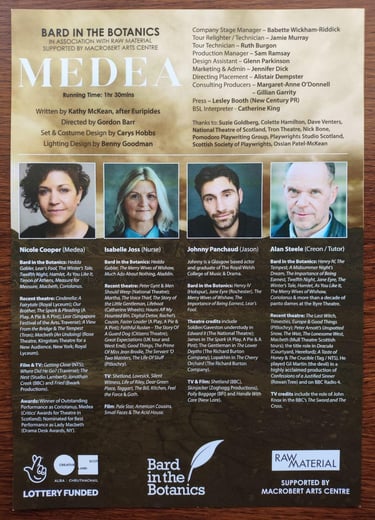
Writer:
Kathy McKean, after Euripides
Director:
Gordon Barr
Set & Costume Design:
Carys Hobbs
Lighting Design:
Benny Goodman
Design Assistant:
Glenn Parkinson
Stage Manager:
Babette Wickham-Riddick
Production Manager:
Sam Ramsay
Cast:
Nicole Cooper, Isabella Joss, Johnny Panchaud, Alan Steele
BSL Interpreter:
Catherine King
Tech team:
Jamie Murray, Ruth Burgon
Marketing & Admin:
Jennifer Dick
Press:
Lesley Booth
Consulting Producers:
Margaret-Anne O'Donnell, Gillian Garrity
Modernising the classics can be a risky business but Kathy McKean has knocked it out of the park with this – Bard in the Botanics’ MEDEA is a gut-punch of raw feminine rage made easily accessible for a modern audience. Originally performed in 431BC Euripides’ The Medea is perhaps the quintessential Greek tragedy – though apparently not well received at the time – containing commentary on the patriarchy and its unjust treatment of women as well as touching on themes of immigration and deportation that surely hit home today.
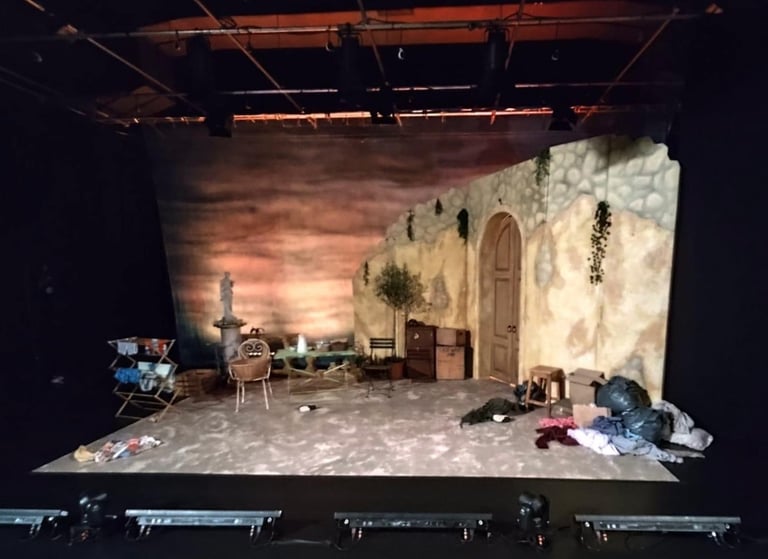
Set in Corinth, Carys Hobbs’ set is evocative of the architecture and climate of the Mediterranean with a mismatched and worn down bistro set that would not be out of place in an actual Grecian courtyard. All of the action of the play takes place in a single location – that being the courtyard of Medea’s house which itself tells a story; children’s toys are scattered about while their clothes are drying on a rickety little airer, there’s a collection of suitcases, crates and bin-bags accumulating on either side of the door showcasing a life being packed away. The foundations of the house are littered with cracks, vines growing out of gaps in the walls and the stone balustrade denoting the boundary of the courtyard is falling apart. Amongst all this wear and tear is a plinth holding a classical Greek statue of a woman, unblemished by the realities of life and injustice.
“This is not a love story. This is not a story of love.
The opening lines of the play, delivered by Isabelle Joss as the Nurse leave no room for misinterpretation – Medea is a tragedy built on betrayal and desperation, not romance and it is imperative the audience understand this from the beginning. Medea gave up everything at the behest of Jason and has now been cast aside and the nurse sympathises with her. She ensures that the audience, like the original plays chorus of Corinthian women, see the cruelty and injustice of Jason’s actions and the validity in Medea’s pain. Validity which is immediately questioned by the arrival of the Tutor, a man, who introduces the idea that Medea’s social ostracization is a result of her own behaviour in being visibly – or in this particular case audibly – enraged by Jason’s treatment of her, a view that the nurse pushes against while the Tutor remains uncompromising in his opinion and simply leaving the situation when Medea physically appears on stage.
Nicole Cooper is striking as the titular Medea – graceful, powerful, and grieving the life she and Jason had built in Corinth with their children. When Medea is left alone on stage the delineation between actor and audience becomes blurred as the house lights rise and we the audience become a more tangible part of the play. In Euripides’ play there is an ever-present chorus of Corinthian women, in McKean’s the Nurse takes on the role of narrating at the beginning and end of the play but it is us, the audience who become Medea’s witnesses. We are a silent chorus of ‘Corinthian women’ who Medea is both sympathised with and judged by.
Upon his arrival to Medea’s home, Creon accuses her of “howling” comparing her to something wild and suggesting her rage is exaggerated and unnecessary. Medea responds with a rhetorical “What, like an animal?”, she knows that the man intruding on her home sees her as lesser and she will not let him skirt around his judgement – if she is to be compared to a beast let him compare her to one directly not in veiled comments. It is noteworthy that Creon is made visually uncomfortable by this direct confrontation and is quick to move on from ridiculing her behaviour to the topic of his arrival – the exile of Medea and her children. Medea’s shock and horror at this news is understandable; despite being abandoned by her husband and surrounded by people who view her as inferior due to her cultural differences, Corinth has become her home. She is already exiled from her homeland of Colchis due to the aid she gave Jason in claiming the golden fleece as well as Jason’s home Iolches. It is important to remember here that unlike Corinth and Iolches, Colchis is not a Mediterranean kingdom within what is now Greece but in present-day Georgia and as such Medea is only legally allowed to reside in the Greek kingdoms by virtue of her marriage to Jason – effectively their marriage being annulled results in her deportation the same as a modern day green-card is rendered obsolete if it was gained through a marriage that broke down within a set number of years. While Euripides’ The Medea is lauded as an early feminist work criticising the treatment of women by the patriarchy I believe of equal importance is the often overlooked commentary on immigration. McKean’s writing however leaves no room for doubt that Medea’s status as an immigrant is of equal significance when it comes to her treatment within Corinth and the other Greek kingdoms as her being a woman is. It is because she is an immigrant that she has nowhere else to go; without a husband native to a Greek kingdom she is not guaranteed safety or the ability to live in any of them, at the same time she has been exiled from her homeland due to the actions she took to support and protect Jason. Creon’s refusal to look at Medea when she begs to be allowed to stay in what has become her only available home demonstrates that while he is determined to deport her without another country lined up to accept her, he is unable face the consequent pain he causes; his decision has consequences and here he is unable to face the harm he causes. This contrasts beautifully with the strength Medea shows at the end of the play when – unlike Creon – she does not flinch away from witnessing the pain she causes.
Jason arrives looking slicked back and somewhat smarmy, he would fit right in on one of those manosphere tech-bro podcasts the algorithm likes showing us all clips of. Here we are truly confronted with the xenophobia Medea has faced, even by the man who once claimed to love her. Her pain, grief and anger are reduced to a product of her ‘less civilised’ upbringing within Colchis’ culture and used to accuse her of bringing exile upon herself, as if the existence of her children is not seen as a potential threat to Creon & his daughter at this point. “You cannot help what you are.” Jason accuses, referring to Medea’s willingness to express her displeasure and pain rather than silently submit to the decisions of the men around her, “I had hoped you’d spent enough time here [...] with me” he exclaims, revealing that in part her alure could have been due to a desire to tame her; Jason saw Medea and wished to have her power on his side, her passion aimed at him, and to subjugate her to his will and it is in this last goal he has ultimately failed. This is likely to especially hit close to-home for women of colour, the stereotype of ‘the angry black woman’ often being used to invalidate their lived experiences – it is notable within the casting that all of the ‘Greek’ characters are played by white actors while Medea, the ‘foreign’ and ‘unruly’ character is played by a mixed actor of Zambian and Greek heritage, giving these lines additional strength in their delivery and meaning. Cooper’s use of Greek alongside English in her performance, as well as moments of ‘reaching’ for the English words she needs at times further cements her as an immigrant having had to learn and speak in a second language to be understood, the fact that in moments of re-enacting conversations with her children she switches between the two languages is a beautiful touch; despite Jason’s hopes to erase her cultural upbringing and replace it with that of the Greek kingdoms, Medea knows and honours her culture and wishes to share it with her children.
Jason loses nothing by annulling their marriage, while Medea is made undesirable as a fallen woman, society now viewing her as having slept with and born the children of a man she is not married to. The moment Jason denies making Medea untouchable and says she did that to herself, as if their marriage and their children are not the result of his own seduction of her, will hit many women close to home even in the modern age with the resurgence of purity culture and the idea that a man who sleeps around is a stud, while a woman is considered to be ruined or ‘damaged goods’. Later, when Medea has made her plan and sends the nurse to call Jason back so she can ‘apologise’ she plays into his desire to have tamed her to gain his unknowing cooperation in her revenge. In this adaptation Bard in the Botanics leans into Jason’s claim of still loving Medea – not by showing him to actually love her but by emphasising that his initial plan was to marry the Corinthian princess while keeping Medea ‘on the side’. As Medea presents herself to be contrite and Jason is only half listening as he leers at her chest and initiates physical intimacy, which Medea must play along with for her manipulation to succeed – it makes for uncomfortable viewing as Jason overlooks visible signs of her discomfort and Medea herself feels she must initiate a kiss to distract him – something that many women have felt the need to do to protect themselves from controlling partners.
“We are nothing without cracks and through the cracks I am screaming”
While the children of Medea and Jason are shown to exist through the set dressing; their clothes drying on the airer and their toys scattered about Gordon Barr makes them truly tangible despite us never seeing them by the simple decision of having an offstage present through a ball through the open door. As Jason takes the ball and rushes to play with his children their existence becomes far more real; they no longer seem like a nebulous construct to the audience but actual people. Later this is built on by Medea as she describes her children to us, once again alone on stage and with the audience lit up – blurring the lines between the stage and auditorium. Medea’s love for her children is apparent in her attention to details about their personalities, what makes them different from each other and what they have inherited from both her and Jason – it is through Medea that the children are brought to life on stage through her descriptions and reminiscing of happier times before the family arrived in Corinth. Here, Medea’s love for her children comes to overwhelm her fury at Jason and she hopes, for a moment, to be able to escape with them – changing her mind on her revenge and scrambling to gather their things before the devastating realisation that “It’s too late. I’m too late. It’s done.”. Her revenge is already in motion, Jason has already taken their sons to present the deadly crown and cloak to the Princess of Corinth – the murder weapons delivered by the unknowing hands of her children has condemned them – the people of Corinth will hunt them as they will hunt her and in the end she wants them to be comfortable and happy, untouched by the horrors of the world until their final moments. Ultimately she will kill them herself, having ensured they are comfortable in their own room in their own home, by slitting their throats – a swift death with minimal suffering.
Medea’s anguish at having a change of heart is however short lived as the Tutor arrives breathless from the palace with the news that Creon had died alongside his daughter and her glee at the revelation that he “died on his knees” and “howling like an animal” – having reduced him to the same position he had previously reduced her to. While Medea is unsurprised by the Tutor’s recollection of events - having Jason immobile while someone he claims to love is in pain - Cooper’s delivery also contains a note of disappointment, not that he isn’t devastated but that he is still apparently an entirely passive presence in his own life – having realised too late in regards to their relationship (having done all the work to gain the Golden Fleece and protect him while he stood behind her) – there is almost a sense that she had hoped he might have changed just enough to get involved; to try and help his betrothed and father-in-law, to take action in a moment of importance.
After the Tutor’s terrified exit, Medea composes herself and heads into the house to see her children for the last time – a chilling moment masterfully conveyed through her blank expression and the silence broken only by the scrape of the knife she has grabbed from the table – the same knife she had used to cut some fruit in her first appearance on stage and that the audience had likely forgotten had been present on stage the entire time. The Nurse enters as Medea exits and the decision to keep the stage silent as she worries over Medea’s expression and notices the children’s clothes arranged to mimic a joint burial arrangement adds to the tension as she realises what is happening and runs back into the house. Joss’s scream is heart wrenching as it breaks the heavy silence from off-stage as Medea calmly re-enters with bloody hands and knife – calmly collecting a basin of water and cleaning herself up as the Nurse returns with a shell-shocked expression and blood coating her hands and clothes, evidence of her efforts to stem the bleeding and save the children. The contrast between the two women is stark and the tension is only broken by a panicked Jason crashing into the scene in a frenzy to run from Corinth with his children. Upon being told that the blood staining the nurse’s clothes is “my blood. And yours.” by Medea and realising the implication, all of Jason’s previous posturing collapses – while Medea stands regally and the Nurse mourns with dignity Jason becomes a wailing lump on the floor, screeching “I’ll kill you!” while writhing at Medea’s feet. While Panchaud’s previous appearances as Jason were smarmy now he shows us how truly pathetic the man lauded as a hero by taking credit for his wife’s work is. As Medea reminds him; “you wanted a monster” and she simply delivered his wish, just as she has always done.
“The sun is rising – and so am I.”
Medea’s final exit is not through the door to the house but by walking off the stage and past the audience towards the front-of-house – a subtle but effective visualisation of her otherworldly departure from Corinth as McKean remains true to the original text’s deus ex machina ending with the Nurse telling the audience how “the sun himself” lifted her away, the sun god Helios (Medea’s grandfather) choosing to save her from the Corinthians. In something of a circular narrative, the Nurse reminds the audience that “This is not a love story. This is not a story of love.” And yet, despite everything Joss’s Nurse does not condemn Medea – instead remaining sympathetic to her decisions despite disagreeing with and being haunted forevermore by them, telling us “She did what she could. And so did I.” as the play ends. True to her deal with Creon, Medea does not “pollute another sunrise” in Corinth.
“I am who I have always been. You knew who I was when you chose me. You knew who I was when you deserted me.”
"I am not what others say about me."
"I have a right to be heard."